Why Is Caching Used to Increase Read Performance It Makes the First Read Faster

Diagram of a CPU memory cache functioning
In calculating, a enshroud ( KASH )[1] is a hardware or software component that stores data so that hereafter requests for that data tin be served faster; the data stored in a cache might be the result of an earlier computation or a re-create of information stored elsewhere. A enshroud striking occurs when the requested data can be constitute in a enshroud, while a cache miss occurs when it cannot. Enshroud hits are served by reading data from the enshroud, which is faster than recomputing a issue or reading from a slower data store; thus, the more requests that tin can be served from the cache, the faster the arrangement performs.[2]
To be price-effective and to enable efficient use of data, caches must be relatively small. However, caches have proven themselves in many areas of computing, because typical computer applications access data with a loftier degree of locality of reference. Such access patterns exhibit temporal locality, where data is requested that has been recently requested already, and spatial locality, where information is requested that is stored physically close to information that has already been requested.
Motivation [edit]
There is an inherent merchandise-off between size and speed (given that a larger resource implies greater concrete distances) but also a tradeoff between expensive, premium technologies (such equally SRAM) vs cheaper, easily mass-produced commodities (such as DRAM or hard disks).
The buffering provided by a cache benefits 1 or both of latency and throughput (bandwidth):
Latency [edit]
A larger resources incurs a pregnant latency for admission – east.k. information technology can take hundreds of clock cycles for a modern 4 GHz processor to reach DRAM. This is mitigated by reading in big chunks, in the hope that subsequent reads will be from nearby locations. Prediction or explicit prefetching might also guess where time to come reads will come from and make requests ahead of time; if done correctly the latency is bypassed birthday.
Throughput [edit]
The use of a enshroud also allows for college throughput from the underlying resource, by assembling multiple fine grain transfers into larger, more efficient requests. In the instance of DRAM circuits, this might be served by having a wider information bus. For example, consider a program accessing bytes in a 32-chip address space, merely being served past a 128-bit off-fleck data bus; individual uncached byte accesses would allow just 1/16th of the total bandwidth to exist used, and fourscore% of the data movement would be retentiveness addresses instead of data itself. Reading larger chunks reduces the fraction of bandwidth required for transmitting accost information.
Operation [edit]
Hardware implements cache as a block of memory for temporary storage of data likely to be used again. Fundamental processing units (CPUs) and hard disk drives (HDDs) frequently use a hardware-based cache, while spider web browsers and web servers commonly rely on software caching.
A cache is fabricated up of a pool of entries. Each entry has associated information, which is a copy of the aforementioned information in some backing shop. Each entry too has a tag, which specifies the identity of the data in the backing store of which the entry is a re-create. Tagging allows simultaneous cache-oriented algorithms to function in multilayered fashion without differential relay interference.
When the cache client (a CPU, web browser, operating organization) needs to admission information presumed to exist in the bankroll store, it first checks the cache. If an entry can exist found with a tag matching that of the desired information, the data in the entry is used instead. This situation is known equally a cache hit. For example, a spider web browser program might check its local cache on disk to run into if information technology has a local copy of the contents of a web page at a item URL. In this case, the URL is the tag, and the content of the web page is the data. The percentage of accesses that result in enshroud hits is known as the hit charge per unit or hit ratio of the enshroud.
The alternative state of affairs, when the cache is checked and institute not to incorporate any entry with the desired tag, is known as a enshroud miss. This requires a more expensive access of data from the bankroll shop. Once the requested data is retrieved, it is typically copied into the cache, ready for the next admission.
During a enshroud miss, another previously existing cache entry is removed in lodge to make room for the newly retrieved information. The heuristic used to select the entry to replace is known as the replacement policy. Ane popular replacement policy, "least recently used" (LRU), replaces the oldest entry, the entry that was accessed less recently than any other entry (see cache algorithm). More than efficient caching algorithms compute the use-hit frequency confronting the size of the stored contents, also as the latencies and throughputs for both the cache and the bankroll store. This works well for larger amounts of data, longer latencies, and slower throughputs, such equally that experienced with hard drives and networks, simply is not efficient for use within a CPU cache.[ citation needed ]
Writing policies [edit]

A write-through cache with no-write allocation
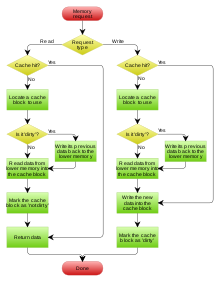
A write-back cache with write resource allotment
When a organization writes data to enshroud, information technology must at some indicate write that information to the backing store as well. The timing of this write is controlled by what is known as the write policy. There are ii bones writing approaches:[iii]
- Write-through: write is washed synchronously both to the cache and to the backing store.
- Write-back (as well called write-backside): initially, writing is done merely to the cache. The write to the bankroll store is postponed until the modified content is about to be replaced by another enshroud cake.
A write-back cache is more complex to implement, since it needs to rails which of its locations take been written over, and mark them as dingy for later writing to the backing store. The data in these locations are written dorsum to the bankroll store only when they are evicted from the enshroud, an issue referred to as a lazy write. For this reason, a read miss in a write-back enshroud (which requires a block to be replaced by another) will oftentimes require two memory accesses to service: ane to write the replaced data from the enshroud back to the shop, and and then one to retrieve the needed data.
Other policies may also trigger data write-back. The client may brand many changes to information in the enshroud, and and so explicitly notify the cache to write back the data.
Since no data is returned to the requester on write operations, a determination needs to be fabricated on write misses, whether or not information would be loaded into the cache. This is defined by these 2 approaches:
- Write allocate (besides called fetch on write): information at the missed-write location is loaded to cache, followed by a write-hit operation. In this approach, write misses are like to read misses.
- No-write allocate (besides called write-no-allocate or write around): information at the missed-write location is non loaded to cache, and is written directly to the backing store. In this approach, information is loaded into the cache on read misses only.
Both write-through and write-back policies can apply either of these write-miss policies, just unremarkably they are paired in this style:[4]
- A write-back enshroud uses write allocate, hoping for subsequent writes (or even reads) to the same location, which is at present buried.
- A write-through enshroud uses no-write allocate. Here, subsequent writes have no advantage, since they however demand to be written directly to the backing store.
Entities other than the cache may change the data in the backing store, in which case the copy in the cache may become out-of-date or dried. Alternatively, when the client updates the data in the cache, copies of those data in other caches will go stale. Communication protocols between the cache managers which keep the data consistent are known as coherency protocols.
Prefetch [edit]
On a enshroud read miss, caches with an demand paging policy read the minimum corporeality from the backing store. For example, need-paging virtual retention reads one page of virtual retention (frequently 4 kBytes) from disk into the disk cache in RAM. For instance, a typical CPU reads a single L2 cache line of 128 bytes from DRAM into the L2 cache, and a single L1 cache line of 64 bytes from the L2 enshroud into the L1 cache.
Caches with a prefetch input queue or more full general anticipatory paging policy go farther—they not just read the clamper requested, but guess that the adjacent clamper or two volition shortly be required, and so prefetch that data into the cache ahead of time. Anticipatory paging is especially helpful when the backing shop has a long latency to read the offset chunk and much shorter times to sequentially read the adjacent few chunks, such equally disk storage and DRAM.
A few operating systems go further with a loader (computing) that always pre-loads the unabridged executable into RAM.
A few caches go even further, not only pre-loading an entire file, simply also starting to load other related files that may soon be requested, such as the page cache associated with a prefetcher or the web cache associated with link prefetching.
Examples of hardware caches [edit]
CPU enshroud [edit]
Small-scale memories on or close to the CPU can operate faster than the much larger main memory. Most CPUs since the 1980s have used one or more caches, sometimes in cascaded levels; modern high-end embedded, desktop and server microprocessors may have as many as six types of enshroud (between levels and functions).[5] Examples of caches with a specific part are the D-cache and I-enshroud and the translation lookaside buffer for the MMU.
GPU cache [edit]
Earlier graphics processing units (GPUs) often had limited read-only texture caches, and introduced Morton order swizzled textures to improve 2D cache coherency. Cache misses would drastically touch on performance, e.1000. if mipmapping was not used. Caching was important to leverage 32-flake (and wider) transfers for texture data that was often as fiddling equally 4 bits per pixel, indexed in complex patterns past arbitrary UV coordinates and perspective transformations in changed texture mapping.
As GPUs advanced (especially with GPGPU compute shaders) they have developed progressively larger and increasingly general caches, including education caches for shaders, exhibiting increasingly mutual functionality with CPU caches. For example, GT200 architecture GPUs did not feature an L2 cache, while the Fermi GPU has 768 KB of last-level enshroud, the Kepler GPU has 1536 KB of final-level cache, and the Maxwell GPU has 2048 KB of last-level enshroud. These caches have grown to handle synchronisation primitives betwixt threads and atomic operations, and interface with a CPU-style MMU.
DSPs [edit]
Digital signal processors have similarly generalised over the years. Earlier designs used scratchpad memory fed by DMA, but modern DSPs such as Qualcomm Hexagon oft include a very similar gear up of caches to a CPU (eastward.k. Modified Harvard architecture with shared L2, split L1 I-cache and D-cache).[6]
Translation lookaside buffer [edit]
A memory management unit (MMU) that fetches page tabular array entries from main memory has a specialized cache, used for recording the results of virtual address to physical address translations. This specialized cache is called a translation lookaside buffer (TLB).[7]
In-network cache [edit]
Information-axial networking [edit]
Data-centric networking (ICN) is an approach to evolve the Net infrastructure abroad from a host-centric paradigm, based on perpetual connectivity and the end-to-cease principle, to a network architecture in which the focal point is identified information (or content or data). Due to the inherent caching adequacy of the nodes in an ICN, it tin exist viewed as a loosely connected network of caches, which has unique requirements of caching policies. Yet, ubiquitous content caching introduces the challenge to content protection against unauthorized access, which requires extra care and solutions.[8] Unlike proxy servers, in ICN the cache is a network-level solution. Therefore, information technology has chop-chop irresolute cache states and college asking arrival rates; moreover, smaller cache sizes further impose a dissimilar kind of requirements on the content eviction policies. In detail, eviction policies for ICN should be fast and lightweight. Various cache replication and eviction schemes for different ICN architectures and applications have been proposed.
Policies [edit]
Fourth dimension aware least recently used (TLRU) [edit]
The Time aware Least Recently Used (TLRU)[9] is a variant of LRU designed for the situation where the stored contents in cache have a valid life fourth dimension. The algorithm is suitable in network enshroud applications, such as Information-centric networking (ICN), Content Commitment Networks (CDNs) and distributed networks in general. TLRU introduces a new term: TTU (Time to Utilise). TTU is a time stamp of a content/folio which stipulates the usability time for the content based on the locality of the content and the content publisher proclamation. Owing to this locality based time stamp, TTU provides more control to the local administrator to regulate in network storage. In the TLRU algorithm, when a piece of content arrives, a cache node calculates the local TTU value based on the TTU value assigned by the content publisher. The local TTU value is calculated by using a locally defined office. One time the local TTU value is calculated the replacement of content is performed on a subset of the total content stored in cache node. The TLRU ensures that less popular and small life content should exist replaced with the incoming content.
Least frequent recently used (LFRU) [edit]
The To the lowest degree Frequent Recently Used (LFRU)[10] cache replacement scheme combines the benefits of LFU and LRU schemes. LFRU is suitable for 'in network' cache applications, such as Information-centric networking (ICN), Content Commitment Networks (CDNs) and distributed networks in general. In LFRU, the cache is divided into two partitions chosen privileged and unprivileged partitions. The privileged partition can exist defined as a protected partition. If content is highly popular, it is pushed into the privileged partition. Replacement of the privileged partition is washed as follows: LFRU evicts content from the unprivileged partition, pushes content from privileged partition to unprivileged partition, and finally inserts new content into the privileged partition. In the above procedure the LRU is used for the privileged partition and an approximated LFU (ALFU) scheme is used for the unprivileged partition, hence the abbreviation LFRU. The basic idea is to filter out the locally popular contents with ALFU scheme and button the popular contents to i of the privileged segmentation.
Weather forecast [edit]
Back in 2010 The New York Times suggested "Type 'weather condition' followed by your zip code."[11] By 2011, the utilise of smartphones with weather condition forecasting options was overly taxing AccuWeather servers; ii requests within the aforementioned park would generate carve up requests. An optimization by edge-servers to truncate the GPS coordinates to fewer decimal places meant that the cached results from the earlier query would be used. The number of to-the-server lookups per day dropped by half.[12]
Software caches [edit]
Disk cache [edit]
While CPU caches are generally managed entirely by hardware, a multifariousness of software manages other caches. The folio cache in main memory, which is an example of disk cache, is managed by the operating system kernel.
While the disk buffer, which is an integrated part of the hard disk, is sometimes misleadingly referred to as "disk cache", its main functions are write sequencing and read prefetching. Repeated enshroud hits are relatively rare, due to the small size of the buffer in comparison to the bulldoze's chapters. However, high-cease deejay controllers ofttimes have their ain on-board cache of the hard disk drive's data blocks.
Finally, a fast local hd can too cache information held on fifty-fifty slower data storage devices, such equally remote servers (web cache) or local record drives or optical jukeboxes; such a scheme is the principal concept of hierarchical storage management. Also, fast flash-based solid-state drives (SSDs) can be used as caches for slower rotational-media hard disk drives, working together as hybrid drives or solid-state hybrid drives (SSHDs).
Spider web cache [edit]
Spider web browsers and spider web proxy servers employ web caches to store previous responses from web servers, such as spider web pages and images. Spider web caches reduce the amount of data that needs to be transmitted beyond the network, every bit information previously stored in the enshroud can often be re-used. This reduces bandwidth and processing requirements of the web server, and helps to improve responsiveness for users of the spider web.[13]
Web browsers employ a congenital-in web cache, just some Internet service providers (ISPs) or organizations also utilise a caching proxy server, which is a web enshroud that is shared amidst all users of that network.
Another form of enshroud is P2P caching, where the files most sought for by peer-to-peer applications are stored in an Internet access provider cache to advance P2P transfers. Similarly, decentralised equivalents be, which allow communities to perform the aforementioned task for P2P traffic, for instance, Corelli.[14]
Memoization [edit]
A enshroud can store data that is computed on demand rather than retrieved from a backing store. Memoization is an optimization technique that stores the results of resources-consuming function calls inside a lookup tabular array, allowing subsequent calls to reuse the stored results and avoid repeated computation. It is related to the dynamic programming algorithm blueprint methodology, which can also exist thought of equally a ways of caching.
Other caches [edit]
The Bind DNS daemon caches a mapping of domain names to IP addresses, every bit does a resolver library.
Write-through operation is common when operating over unreliable networks (like an Ethernet LAN), because of the enormous complication of the coherency protocol required between multiple write-dorsum caches when advice is unreliable. For instance, web page caches and client-side network file system caches (like those in NFS or SMB) are typically read-only or write-through specifically to keep the network protocol simple and reliable.
Search engines likewise frequently make spider web pages they have indexed available from their cache. For example, Google provides a "Cached" link next to each search result. This can prove useful when web pages from a spider web server are temporarily or permanently inaccessible.
Another type of caching is storing computed results that volition probable exist needed again, or memoization. For example, ccache is a program that caches the output of the compilation, in society to speed up afterward compilation runs.
Database caching tin substantially improve the throughput of database applications, for example in the processing of indexes, information dictionaries, and frequently used subsets of data.
A distributed cache[fifteen] uses networked hosts to provide scalability, reliability and performance to the application.[16] The hosts can exist co-located or spread over different geographical regions.
Buffer vs. cache [edit]
The semantics of a "buffer" and a "cache" are not totally different; even and then, there are key differences in intent between the process of caching and the process of buffering.
Fundamentally, caching realizes a performance increase for transfers of data that is being repeatedly transferred. While a caching arrangement may realize a performance increase upon the initial (typically write) transfer of a data item, this performance increase is due to buffering occurring within the caching system.
With read caches, a data item must take been fetched from its residing location at to the lowest degree once in guild for subsequent reads of the data item to realize a performance increase by virtue of being able to be fetched from the cache'southward (faster) intermediate storage rather than the data's residing location. With write caches, a performance increase of writing a information item may exist realized upon the first write of the data detail by virtue of the data detail immediately being stored in the cache'southward intermediate storage, deferring the transfer of the data detail to its residing storage at a subsequently stage or else occurring as a background procedure. Contrary to strict buffering, a caching process must attach to a (potentially distributed) cache coherency protocol in order to maintain consistency between the cache'due south intermediate storage and the location where the data resides. Buffering, on the other hand,
- reduces the number of transfers for otherwise novel data amongst communicating processes, which amortizes overhead involved for several small transfers over fewer, larger transfers,
- provides an intermediary for communicating processes which are incapable of straight transfers amongst each other, or
- ensures a minimum data size or representation required by at to the lowest degree one of the communicating processes involved in a transfer.
With typical caching implementations, a data detail that is read or written for the first fourth dimension is finer being buffered; and in the case of a write, mostly realizing a performance increase for the awarding from where the write originated. Additionally, the portion of a caching protocol where private writes are deferred to a batch of writes is a form of buffering. The portion of a caching protocol where individual reads are deferred to a batch of reads is besides a form of buffering, although this form may negatively impact the performance of at least the initial reads (fifty-fifty though it may positively touch on the functioning of the sum of the individual reads). In practice, caching almost always involves some form of buffering, while strict buffering does not involve caching.
A buffer is a temporary memory location that is traditionally used because CPU instructions cannot straight address data stored in peripheral devices. Thus, addressable retention is used as an intermediate stage. Additionally, such a buffer may be feasible when a large cake of information is assembled or disassembled (as required by a storage device), or when data may be delivered in a different gild than that in which it is produced. Also, a whole buffer of information is usually transferred sequentially (for case to hd), so buffering itself sometimes increases transfer performance or reduces the variation or jitter of the transfer'south latency as opposed to caching where the intent is to reduce the latency. These benefits are present even if the buffered data are written to the buffer once and read from the buffer once.
A enshroud also increases transfer performance. A part of the increment similarly comes from the possibility that multiple pocket-sized transfers will combine into one large block. But the main operation-proceeds occurs because there is a good chance that the same information will be read from cache multiple times, or that written information will soon exist read. A enshroud'southward sole purpose is to reduce accesses to the underlying slower storage. Enshroud is as well usually an brainchild layer that is designed to be invisible from the perspective of neighboring layers.
Come across also [edit]
- Enshroud coloring
- Enshroud hierarchy
- Cache-oblivious algorithm
- Cache stampede
- Cache language model
- Cache manifest in HTML5
- Dirty flake
- Five-minute rule
- Materialized view
- Memory hierarchy
- Pipeline burst cache
- Temporary file
References [edit]
- ^ "Enshroud". Oxford Dictionaries. Oxford Dictionaries. Retrieved 2 August 2016.
- ^ Zhong, Liang; Zheng, Xueqian; Liu, Yong; Wang, Mengting; Cao, Yang (February 2020). "Cache hit ratio maximization in device-to-device communications overlaying cellular networks". China Communications. 17 (ii): 232–238. doi:10.23919/jcc.2020.02.018. ISSN 1673-5447. S2CID 212649328.
- ^ Bottomley, James (1 January 2004). "Understanding Caching". Linux Journal . Retrieved 1 October 2019.
- ^ John L. Hennessy; David A. Patterson (2011). Computer Architecture: A Quantitative Arroyo. Elsevier. pp. B–12. ISBN978-0-12-383872-viii.
- ^ "Intel Broadwell Cadre i7 5775C '128MB L4 Enshroud' Gaming Behemoth and Skylake Core i7 6700K Flagship Processors Finally Available In Retail". 25 September 2015. Mentions L4 cache. Combined with separate I-Enshroud and TLB, this brings the total 'number of caches (levels+functions) to vi
- ^ "qualcom Hexagon DSP SDK overview".
- ^ Frank Uyeda (2009). "Lecture 7: Memory Direction" (PDF). CSE 120: Principles of Operating Systems. UC San Diego. Retrieved 4 December 2013.
- ^ Bilal, Muhammad; et al. (2019). "Secure Distribution of Protected Content in Information-Centric Networking". IEEE Systems Periodical. 14 (2): 1–12. arXiv:1907.11717. Bibcode:2019arXiv190711717B. doi:10.1109/JSYST.2019.2931813. S2CID 198967720.
- ^ Bilal, Muhammad; et al. (2017). "Time Enlightened To the lowest degree Contempo Used (TLRU) Cache Management Policy in ICN". IEEE 16th International Conference on Advanced Communication Engineering science (ICACT): 528–532. arXiv:1801.00390. Bibcode:2018arXiv180100390B. doi:10.1109/ICACT.2014.6779016. ISBN978-89-968650-3-2. S2CID 830503.
- ^ Bilal, Muhammad; et al. (2017). "A Enshroud Direction Scheme for Efficient Content Eviction and Replication in Cache Networks". IEEE Access. 5: 1692–1701. arXiv:1702.04078. Bibcode:2017arXiv170204078B. doi:10.1109/Admission.2017.2669344. S2CID 14517299.
- ^ Simon Mackie (3 May 2010). "9 More Simple Google Search Tricks". New York Times.
- ^ Chris Murphy (30 May 2011). "5 Lines Of Code In The Cloud". InformationWeek. p. 28.
300 meg to 500 million fewer requests a day handled past AccuWeather servers
- ^ Multiple (wiki). "Web application caching". Docforge. Archived from the original on 12 December 2019. Retrieved 24 July 2013.
- ^ Gareth Tyson; Andreas Mauthe; Sebastian Kaune; Mu Mu; Thomas Plagemann. Corelli: A Dynamic Replication Service for Supporting Latency-Dependent Content in Community Networks (PDF). MMCN'09. Archived from the original (PDF) on 18 June 2015.
- ^ Paul, S; Z Fei (one February 2001). "Distributed caching with centralized control". Figurer Communications. 24 (2): 256–268. CiteSeerX10.1.one.38.1094. doi:10.1016/S0140-3664(00)00322-iv.
- ^ Khan, Iqbal (July 2009). "Distributed Caching on the Path To Scalability". MSDN. 24 (7).
Further reading [edit]
- "What Every Developer Should Know About Memory"
- "Caching in the Distributed Surround"
Source: https://en.wikipedia.org/wiki/Cache_%28computing%29

Postar um comentário for "Why Is Caching Used to Increase Read Performance It Makes the First Read Faster"